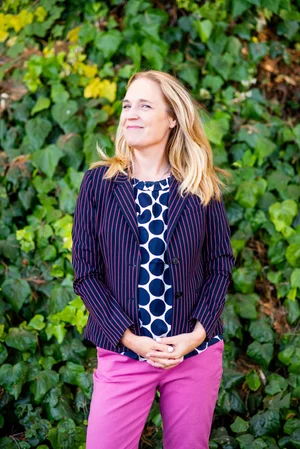
Nature Is Asking You a Question This Week
Nature Is Asking You a Question This Week
Look up. This week of the full moon eclipse moving across the sky — a moment when the moon slips into the earth's shadow and goes dark for a while before it returns, full and bright, on the other side.
I'm not going to give you a horoscope. That's not what this newsletter is for. I use astrology the way I use a lot of tools in this work — not as a prediction machine, not as an authority telling you what's going to happen to you, but as a prompt. A way of tuning into the rhythms that are already happening in nature and asking:
What does this bring up in me? What question is trying to surface right now?
And an eclipse, whatever else it is astronomically, is a striking image for something a lot of my clients are quietly circling: the moment right before a leap. The moon doesn't vanish and reappear identical. Something happens in that dark passage. It comes back around, but changed, more illuminated than it was going in.
That's the invitation I want to sit with today. Not "what does the eclipse mean for your sign," but: where in your life are you standing at the edge of your own dark passage — the leap you keep almost taking?
Playing Big, and Why It's So Hard to Actually Do
I did my training with Tara Mohr's Playing Big work, and one thing that has stayed with me for years is her distinction between a calling and an ambition. A calling doesn't announce itself with confidence. It usually shows up quietly, almost embarrassingly — a pull toward something you don't yet have the credentials, the certainty, or the nerve for. And the resistance you feel around it isn't proof it's wrong for you. It's often the opposite. Feeling underqualified, feeling exposed, feeling like who am I to want this — Tara calls this a telltale sign you're standing in front of something real.
I see this constantly in my coaching practice, especially with women moving through midlife. The pattern is remarkably consistent: a woman who has spent two decades being excellent at the life she built — the career, the marriage, the role she plays for everyone around her — starts to feel a low hum of something else. Not despair, exactly. More like a persistent, inconvenient truth she'd rather not look at directly. A next chapter that has no business plan, no clear five-year projection, no guarantee.
And so she waits. She waits for the fear to go away before she'll leap. Most of us do. We treat fear as a stop sign instead of what it actually is most of the time: information that we're finally standing close enough to something that matters.
The eclipse, as a symbol, doesn't ask you to leap without the dark part. It shows you that the dark part is the passage, not a detour from it. The moon doesn't skip its own shadow to get to full again.
So here's the question I'd actually like you to sit with this week, away from any screen, maybe on a walk:
What is the leap I keep almost taking?
And what would it mean to stop waiting for it to feel safe first?
If "Playing Big" Feels Too Far From Where You Are — Start Here
I want to say something directly to the person reading this who just felt a small flinch of okay but that's not me right now. Maybe you're not in a place to think about leaping into anything. Maybe you're in survival mode, running on fumes, barely keeping the current version of your life upright, let alone dreaming up a bigger one.
If that's you: good. This section is for you. You don't have to leap from where you are. You have to start where you are.
One of the most honest things I can tell you — as a coach and as someone who lived this before I ever coached anyone through it — is that "just decide to play big" was never the thing that worked for me. I spent years being told to think bigger, dream bigger, believe bigger, while the actual wiring underneath me — the nervous system exhaustion, the old stories running the show without my permission — stayed exactly the same. Insight wasn't the bottleneck. Access was.
What actually created the opening for me, and for many of the clients I work with now, was ketamine-assisted coaching. Not as an escape, and not as a shortcut around doing the work — as a catalyst. And here's the part I wish someone had explained to me plainly at the time, because it changed how I understood the whole process: this isn't just a shift in perspective, a nice reframe you talk yourself into. It's a measurable shift in the brain itself.
How It Works:
Ketamine works on the glutamate system — the brain's primary channel for learning and neural change — and it triggers the growth of new synaptic connections in the regions that govern mood and thinking. For a window of time afterward, hours to a few days, your brain is more physically capable of forming new patterns: new self-talk, new emotional responses, new ways of relating to a problem you've been circling for years. That's not a metaphor. That's neuroplasticity — the brain's actual, biological capacity to rewire — temporarily elevated. So it isn't only that you see things differently in that window. Your brain has changed in a way that makes the seeing-differently easier to reach, and easier to hold onto once you find it.
That's the throughline I keep coming back to, in my own life and in this work: the medicine doesn't create the insight out of nothing, and it doesn't make the decision for you. It opens a biological window of flexibility.
What you do with that window — the noticing, the integration, the follow-through — that's yours to keep.
If "start where you are" feels more honest to you right now than "play big," I'd love to talk about what that starting point could look like for you. You can schedule a discovery call — no pressure, no pitch, just a conversation about where you are and what might actually move you.
Until then: look up if you can. Let the sky ask its question.
— Rhetta